

VERDICT: Mark Rutte
CONFIDENCE: medium-high
TITLE: Who will Trump speak to in September?
Background
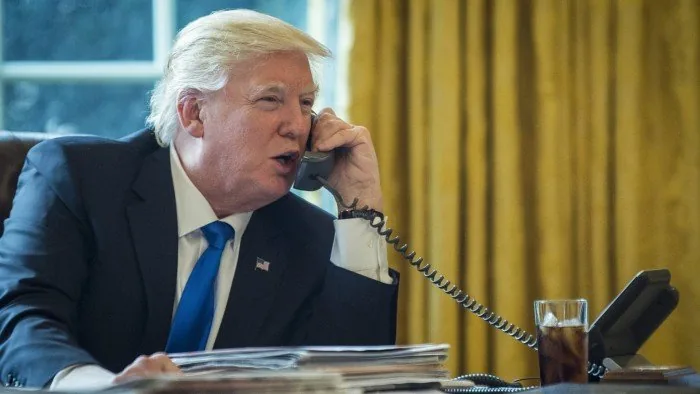
September 2026 marks a critical period for international diplomacy, often punctuated by major global gatherings like the United Nations General Assembly and various bilateral or multilateral summits. The question of who Donald Trump might engage with verbally during this month carries significant weight, especially given his prominent role in global politics, whether as a leading presidential candidate or as the sitting President. His past and potential future foreign policy approaches emphasize direct engagement with key international figures, often bypassing traditional diplomatic channels.
The scope of “speaking” is broad, encompassing any verbal interaction, be it in person, via phone, or video call. This flexibility increases the likelihood of such an event occurring. The resolution relies on credible media reporting or explicit statements from the individuals involved, underscoring the need for verifiable public confirmation. This framework means that even a brief, private conversation could qualify, provided it becomes known through reliable sources.
Understanding Trump’s past patterns of engagement is crucial here. He has historically favored direct communication with leaders he perceives as strategically important, whether allies or adversaries. The individuals listed represent a diverse array of global influence, from heads of state and international organizations to financial powerhouses and opposition figures. The political landscape in 2026 will undoubtedly shape the necessity and frequency of these high-level interactions.
Candidate Analysis
When assessing the likelihood of Donald Trump speaking with various global figures in September 2026, one candidate stands out due to the structural necessity of their role: Mark Rutte. Rutte was confirmed as the next NATO Secretary General in July 2024 and is expected to assume office in October 2024. By September 2026, he will have been at the helm of NATO for nearly two years. The United States is the alliance’s largest contributor and a foundational member, making regular, direct communication between a US President (or a leading presidential figure) and the NATO Secretary General a fundamental aspect of transatlantic relations. Trump has a well-documented history of direct engagement with NATO leadership, often expressing strong views on alliance strategy and burden-sharing. This makes a verbal interaction with Rutte in a diplomatically active month like September highly probable, almost a routine operational requirement.
Comparing Rutte with other highly-rated candidates, the arguments for a September interaction, while strong, are slightly less compelling in terms of structural necessity. Mohammed bin Salman, the Crown Prince of Saudi Arabia, has historically maintained close ties with Trump. While a conversation is certainly plausible given ongoing geopolitical dynamics in the Middle East and energy markets, it might be more event-driven rather than a standing operational requirement. Similarly, Emmanuel Macron, the President of France, is a key European ally, and interactions between US and French leaders are common. However, the specific timing in September 2026 is not as inherently mandated as a discussion with the head of NATO, especially concerning alliance cohesion and strategy.
What remains uncertain for all candidates is the exact timing and public confirmation of any such interaction. Many high-level diplomatic conversations occur privately before any public announcement, or sometimes remain entirely private. The resolution criteria, however, allow for confirmation through official statements, which broadens the scope for a “Yes” resolution even if media reporting is initially absent. It’s also worth noting the market for “Pope Leo XIV,” which has a very low probability; this is likely due to the current Pope being Francis, indicating some markets may include speculative or even non-existent figures.
Market Signals
The current market probabilities offer a secondary lens through which to view these predictions. Mohammed bin Salman leads with a 79.0% probability, followed by Luiz Inácio Lula da Silva at 71.5%, Friedrich Merz at 68.0%, Mark Rutte at 66.0%, Mark Carney at 63.5%, and Emmanuel Macron at 63.0%. These figures suggest a general expectation of engagement with prominent global political and financial figures. Notably, several candidates, including Mark Carney and Emmanuel Macron, have seen slight decreases in their probabilities over the past day, while Mohammed bin Salman and Mark Rutte have shown some upward movement or stability. The significant trading volume for Mark Carney (over $17,000) and Ursula von der Leyen (over $11,000) indicates substantial interest and belief in their potential interactions, despite their probabilities being slightly lower than the top contenders.
Our Verdict
Considering the geopolitical landscape and the established roles of the individuals involved, we assess that Donald Trump is most likely to speak with Mark Rutte in September 2026. Our confidence in this outcome is medium-high. The primary argument rests on Rutte’s confirmed position as NATO Secretary General by that time. The relationship between the United States and NATO is fundamental to global security, and direct communication between the US President (or a leading presidential figure) and the alliance’s chief is a continuous, essential diplomatic function. Trump’s consistent engagement with NATO leadership throughout his political career, often to discuss alliance commitments and future direction, reinforces the expectation of such an interaction. September, being a month ripe with international diplomatic activity, provides ample opportunity for a necessary phone call or meeting to address ongoing security concerns or prepare for upcoming summits.
This assessment is bolstered by the fact that a conversation with the NATO Secretary General is less dependent on specific, unpredictable events than interactions with individual heads of state, which might be driven by particular crises or bilateral agendas. While interactions with figures like Mohammed bin Salman or Emmanuel Macron are highly plausible, the structural imperative for a US leader to engage with the NATO chief provides a more robust foundation for prediction.
Several triggers could further solidify this assessment or shift the probabilities. First, any major geopolitical crisis involving NATO members or requiring alliance coordination would almost certainly necessitate direct communication between Trump and Rutte. Second, public statements from either Trump’s office or NATO headquarters regarding upcoming diplomatic schedules, bilateral meetings, or alliance strategy discussions would serve as strong indicators. Finally, confirmation of Trump’s attendance at any major international summit (e.g., G7, G20, UN General Assembly) where Rutte would also be present would create a high-probability scenario for an in-person verbal interaction.
Sources:
Read more Bitcoin above $78,000 on September 4?
Read more Who will attend a round of US-Iran peace talks by August 31?